Nine in ten Australian businesses are using AI. Only one in four has a strategy.
That gap — between using AI and using it deliberately — is where most of the risk lives. And most of the opportunity.
The AI-Ready Business is a practical, no-jargon guide for Australian business owners and senior managers who want to get AI right. Not eventually. Now.
Written by Lyndall Lohman — former Director of Marketing APAC at Sirtex Medical, MIT Sloan AI strategy graduate, and founder of Headway Co — this book is built on real implementation experience across complex, multi-market environments. It is not a technical manual. You will not find instructions for writing code or building AI models. You will find a clear, structured framework for making AI work in a real business with real constraints.
The six steps cover:
Step 1 — Know Where You Actually Stand. Before you spend a dollar on tools, you need an honest picture of your data quality, process maturity, team readiness, leadership commitment, and technical infrastructure. The AI Readiness Self-Assessment in this chapter tells you exactly where to start.
Step 2 — Map Your Workflows Before You Automate Anything. AI does not fix broken processes. It accelerates them. This step shows you how to identify your highest-value automation opportunities — and which tasks should never be automated at all.
Step 3 — Strategy Before Tools. Every AI vendor will tell you their product solves your problems. Your job is to know what your problems actually are before you sit in the demo. This chapter gives you the Use Case Priority Matrix and the 90-Day Quick Win Principle.
Step 4 — Build Incrementally. The biggest risk in AI implementation is the long runway. This step shows you how to phase your rollout — Foundation, Build, Scale — so you produce visible results quickly and build internal momentum for the harder work that follows.
Step 5 — Measure What Actually Matters. Number of AI tools subscribed to: not a metric. This chapter shows you the four measurements that connect AI investment to real business outcomes — and how to report them to a board in one page.
Step 6 — Make It Stick. Most AI implementations do not fail at launch. They fail six months later. This step gives you the governance framework, literacy programme, and SOP discipline to make sure yours does not.
Every chapter includes a checklist and a printable worksheet. The full toolkit — six worksheets and seven checklists — is available as a free download at headwayco.com.au/ai-toolkit.
This book is for the business owner who knows AI matters but is not sure where to start. The senior manager who has watched three AI initiatives quietly die. The leader who wants to move deliberately rather than reactively — and who understands that the businesses winning with AI are not the ones with the most tools. They are the ones with the clearest strategy.
In five years, there will be two kinds of businesses — those that used AI deliberately, and those that wonder what happened.
This book is for the first kind.
Nine in ten Australian businesses are using AI. Only one in four has a strategy.
That gap — between using AI and using it deliberately — is where most of the risk lives. And most of the opportunity.
The AI-Ready Business is a practical, no-jargon guide for Australian business owners and senior managers who want to get AI right. Not eventually. Now.
Written by Lyndall Lohman — former Director of Marketing APAC at Sirtex Medical, MIT Sloan AI strategy graduate, and founder of Headway Co — this book is built on real implementation experience across complex, multi-market environments. It is not a technical manual. You will not find instructions for writing code or building AI models. You will find a clear, structured framework for making AI work in a real business with real constraints.
The six steps cover:
Step 1 — Know Where You Actually Stand. Before you spend a dollar on tools, you need an honest picture of your data quality, process maturity, team readiness, leadership commitment, and technical infrastructure. The AI Readiness Self-Assessment in this chapter tells you exactly where to start.
Step 2 — Map Your Workflows Before You Automate Anything. AI does not fix broken processes. It accelerates them. This step shows you how to identify your highest-value automation opportunities — and which tasks should never be automated at all.
Step 3 — Strategy Before Tools. Every AI vendor will tell you their product solves your problems. Your job is to know what your problems actually are before you sit in the demo. This chapter gives you the Use Case Priority Matrix and the 90-Day Quick Win Principle.
Step 4 — Build Incrementally. The biggest risk in AI implementation is the long runway. This step shows you how to phase your rollout — Foundation, Build, Scale — so you produce visible results quickly and build internal momentum for the harder work that follows.
Step 5 — Measure What Actually Matters. Number of AI tools subscribed to: not a metric. This chapter shows you the four measurements that connect AI investment to real business outcomes — and how to report them to a board in one page.
Step 6 — Make It Stick. Most AI implementations do not fail at launch. They fail six months later. This step gives you the governance framework, literacy programme, and SOP discipline to make sure yours does not.
Every chapter includes a checklist and a printable worksheet. The full toolkit — six worksheets and seven checklists — is available as a free download at headwayco.com.au/ai-toolkit.
This book is for the business owner who knows AI matters but is not sure where to start. The senior manager who has watched three AI initiatives quietly die. The leader who wants to move deliberately rather than reactively — and who understands that the businesses winning with AI are not the ones with the most tools. They are the ones with the clearest strategy.
In five years, there will be two kinds of businesses — those that used AI deliberately, and those that wonder what happened.
This book is for the first kind.

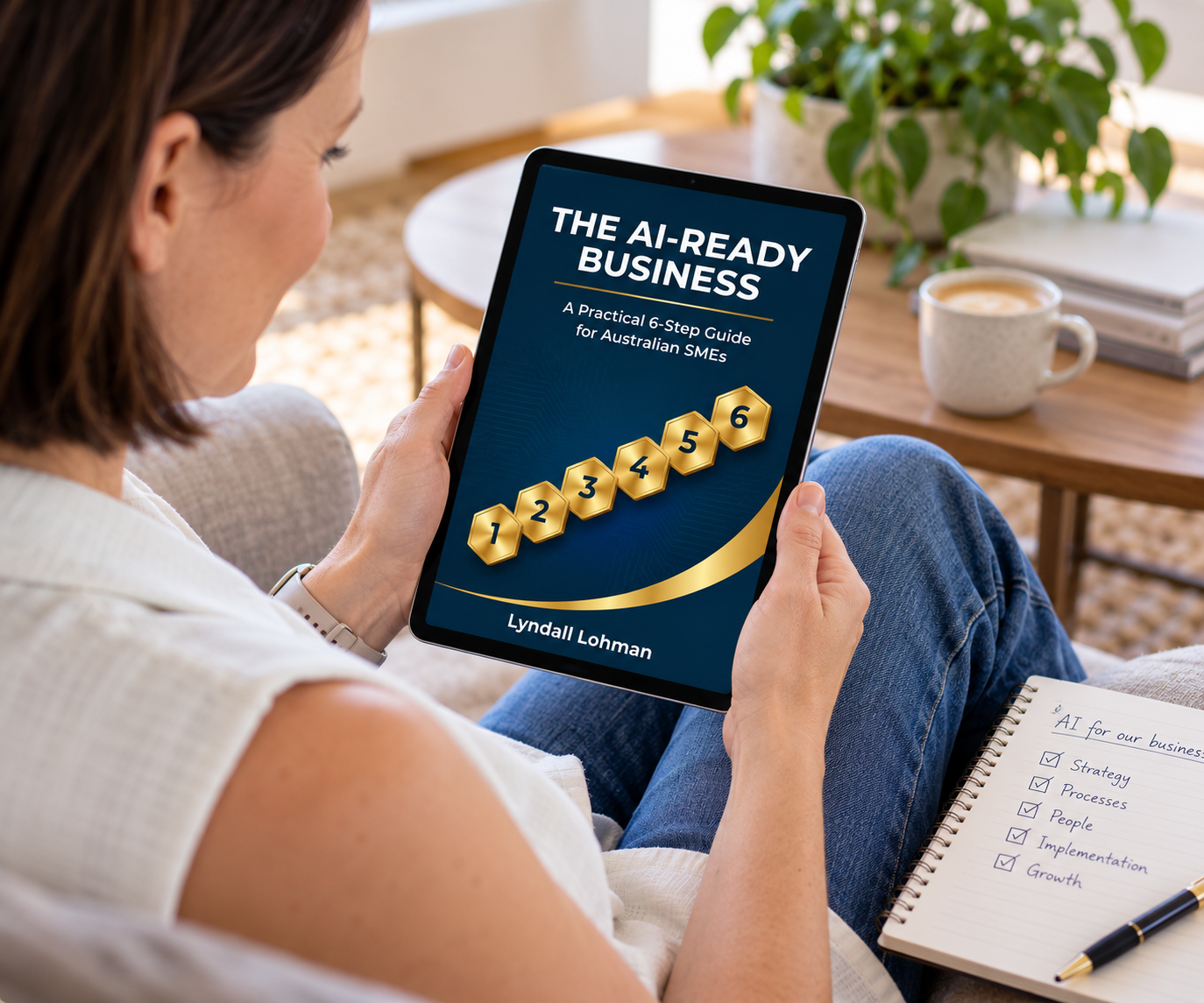 Image 1 of 1